
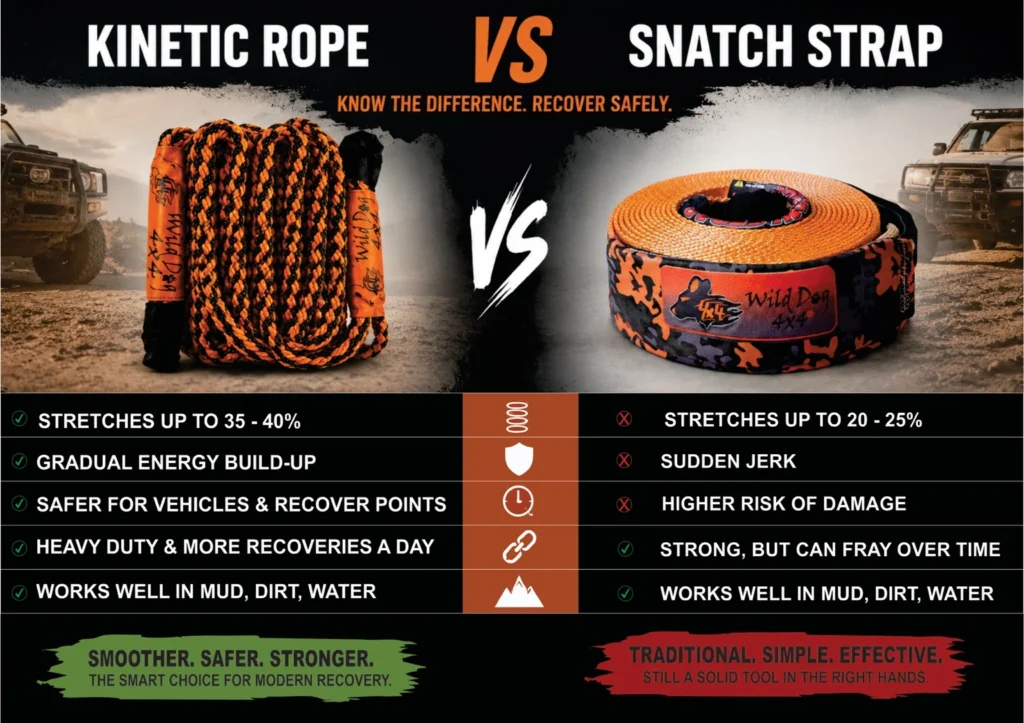
Kinetic Recovery Rope
vs
Snatch Strap:
Head-to-Head Comparison
A direct comparison highlights the key differences between kinetic recovery ropes and snatch straps:
Feature | Kinetic Recovery Rope | Snatch Strap |
Material | Typically double-braided or single braided 100% nylon fibres | Heavy-duty flat 100% nylon webbing Fibres |
Elasticity | High stretch (up to 30 – 40%) Double Braided: +- 30% Single Braided: +- 40% | Lower stretch (up to 20 – 25%) |
Recovery Performance | Smooth, progressive pull that absorbs shock loads | More abrupt pull with greater shock transfer |
Durability | Long service life, highly resistant to wear and fraying | Shorter lifespan; can fatigue after repeated heavy recoveries (max 3 Pulls per 24hours) |
Ideal Applications | Recovering heavily bogged vehicles that require greater pulling force | Straight-line recoveries in sand or mud where less momentum is needed |
Advantages and Disadvantages
Kinetic Recovery Rope
Advantages
- Superior shock absorption reduces stress on vehicles and recovery points..
- Highly durable and suitable for repeated use.
Disadvantages
- Higher purchase cost compared to snatch straps.
- Bulkier and may require more storage space.
Snatch Strap
Advantages
- More affordable and widely available.
- Lightweight and compact, making storage easy.
Disadvantages
- Transfers higher shock loads to recovery points and vehicle components.
- More susceptible to fraying, UV degradation, and wear.
- Often needs replacement after several heavy recovery operations.
Key Safety Guidelines
Regardless of the recovery equipment chosen, proper selection and use are critical for safety:
- Capacity: Select a rope or strap with a Minimum Breaking Strength (MBS) of at least four times the vehicle’s Gross Vehicle Mass (GVM).
- Attachment Points: Always connect recovery gear to rated recovery points using appropriately rated soft shackles or bow shackles. Never attach recovery equipment to a tow ball or wrap it around a tree.
- Controlled Recovery: Use minimal momentum and begin with a gentle pull. Excessive speed or aggressive “run-ups” can damage vehicles, recovery points, or recovery equipment.