
Recovery Gear Load Ratings Explained
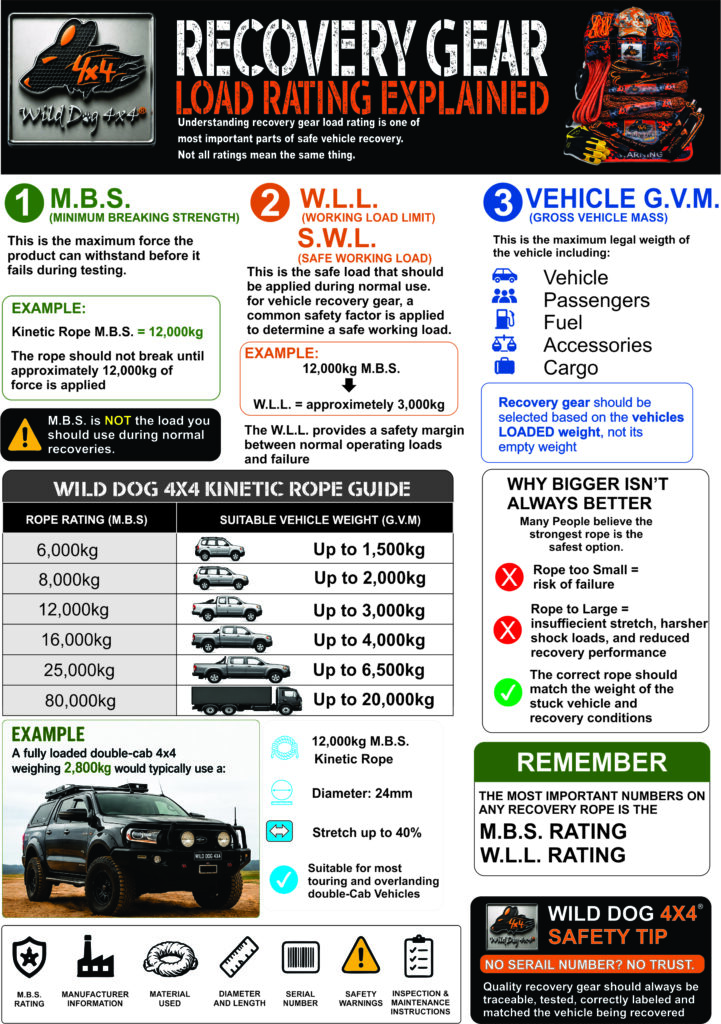
Understanding recovery gear load ratings is one of the most important aspects of safe vehicle recovery. Not all ratings mean the same thing, and selecting recovery equipment based solely on the highest number can lead to poor performance or unsafe recovery situations. Knowing the difference between M.B.S., W.L.L., and your vehicle’s G.V.M. helps ensure that recovery gear is correctly matched to the vehicle being recovered.
M.B.S. – Minimum Breaking Strength
M.B.S. (Minimum Breaking Strength) is the maximum force a recovery product can withstand before it fails during testing. This is the product’s ultimate strength rating and should not be confused with its normal working load.
For example, a kinetic recovery rope with an M.B.S. rating of 12,000kg should not fail until approximately 12,000kg of force is applied under controlled testing conditions. However, this does not mean the rope should be used at 12,000kg during normal recoveries.
W.L.L. / S.W.L. – Working Load Limit and Safe Working Load
The Working Load Limit (W.L.L.) or Safe Working Load (S.W.L.) is the maximum load that should be applied to recovery equipment during normal operation. This rating is calculated by applying a safety factor to the M.B.S. rating, creating a margin between normal operating loads and the point of failure.
As an example, a recovery rope with a 12,000kg M.B.S. would typically have a W.L.L. of approximately 3,000kg. The W.L.L. is the figure that helps determine the safe operating range of the equipment and should always be respected during recoveries.
Vehicle G.V.M. – Gross Vehicle Mass
G.V.M. (Gross Vehicle Mass) is the maximum legal weight of a vehicle when fully loaded. This includes the vehicle itself, passengers, fuel, accessories, recovery equipment, camping gear, luggage, and any additional cargo.
When selecting recovery gear, it is important to use the vehicle’s loaded weight rather than its empty weight. Many vehicles gain hundreds of kilograms once accessories, passengers, fuel, and camping equipment are added.
Choosing the Correct Recovery Rope
Recovery gear should be matched to the loaded weight of the vehicle being recovered. A rope that is too small may fail under load, while a rope that is too large may not stretch sufficiently to absorb kinetic energy effectively. This can result in harsher shock loads, reduced recovery performance, and increased stress on recovery points and vehicle components.
The ideal recovery rope is one that matches the vehicle’s weight and the expected recovery conditions.
Wild Dog 4×4 Kinetic Rope Guide
- 6,000kg M.B.S. – Suitable for vehicles up to 1,500kg G.V.M.
- 8,000kg M.B.S. – Suitable for vehicles up to 2,000kg G.V.M.
- 12,000kg M.B.S. – Suitable for vehicles up to 3,000kg G.V.M.
- 16,000kg M.B.S. – Suitable for vehicles up to 4,000kg G.V.M.
- 25,000kg M.B.S. – Suitable for vehicles up to 6,500kg G.V.M.
- 80,000kg M.B.S. – Suitable for vehicles up to 20,000kg G.V.M.
Practical Example
A fully loaded double-cab 4×4 weighing approximately 2,800kg would typically use a 12,000kg M.B.S. kinetic recovery rope. A rope of this size generally has a diameter of around 24mm and can stretch by up to 40%, making it suitable for most touring, overlanding, and recreational off-road vehicles.
Why Bigger Isn’t Always Better
Many people assume that the strongest recovery rope is automatically the safest option. In reality, recovery equipment works best when correctly matched to the vehicle. An oversized rope may not stretch enough to generate the kinetic energy needed for an efficient recovery, while an undersized rope may be overloaded and fail.
The safest and most effective recovery system is one where the rope, shackles, recovery points, and vehicle weight are all properly matched.
Important Information to Look for on Recovery Gear
Quality recovery equipment should always be clearly labelled and traceable. Key information should include:
- Minimum Breaking Strength (M.B.S.)
- Manufacturer information
- Material used
- Diameter and length
- Serial number
- Safety warnings
- Inspection and maintenance instructions
Safety Tip
Always purchase recovery equipment that is tested, correctly labelled, and traceable. A serial number allows equipment to be tracked back to its manufacturing records and quality control processes.
No Serial Number? No Trust.
The two most important numbers to understand when selecting recovery equipment are the M.B.S. rating and the vehicle’s loaded G.V.M. When these are correctly matched, recoveries become safer, more efficient, and less stressful on both the equipment and the vehicles involved.